

What to Do After Duolingo Spanish: A Teacher's 30-Day Plan
Reviewed against our editorial standards
¡Hola! Alejandra here, Spanish teacher from Buenos Aires.
The short answer
After Duolingo Spanish, keep the habit and change the training. Move most of your study time to listening: short, real conversations between two people, with a transcript, played until the words stop melting together. Your next goal isn’t more units. It’s understanding Spanish that wasn’t written for you.
Before you start, find out where your ears really are. The free Spanish level test takes about two minutes and checks listening only, which is the skill an app score tells you least about.
What did Duolingo actually give you?
More than people admit. If you’ve done the Spanish course for a few months, you probably have:
- A daily habit. That’s the hardest thing in language learning, and you already have it.
- A few hundred useful words and the shapes of common sentences.
- Reading confidence. Spanish no longer looks like a wall of accents.
- The present tense and the basics of the past, at least on paper.
That’s a real foundation. Nothing here asks you to throw it away. The problem starts when you expect the same tool to solve a different problem.
Why do you still freeze when Spanish speakers talk?
Because reading Spanish and hearing Spanish are related skills, not the same skill.
In the app, sentences arrive one at a time, clearly spoken, with the task written on the screen. Real Spanish arrives as one long sound. Words join together, so ¿Qué es eso? (“What’s that?”) sounds like a single word. People don’t wait for you. And half of every conversation is made of small words your course never focused on:
- Bueno, a ver… (“Well, let’s see…”)
- O sea, sí, pero no. (“I mean, yes, but no.”)
- Este… ¿cómo te explico? (“Um… how do I explain this to you?”)
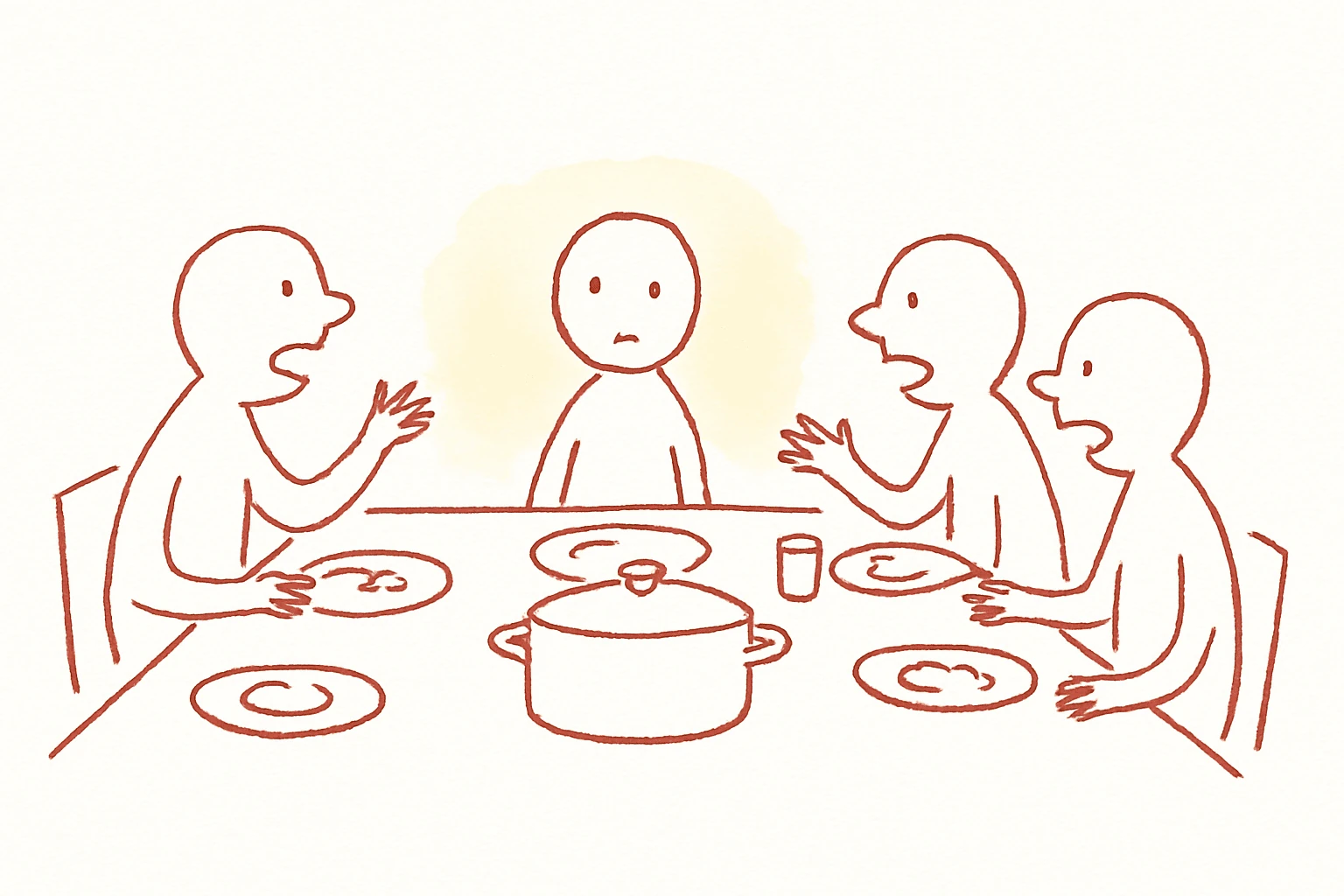
One learner on Reddit put it in one line: “489 day duolingo streak and i still can’t hold a conversation”. Another sat through a Mexican family dinner nearly silent for five hours after a 341-day streak. Neither did anything wrong. They trained for one skill and were tested on another.
What level is Duolingo Spanish?
Duolingo says its Spanish course now teaches up to B2 on the CEFR scale, after an expansion announced in April 2026; before that, most learners could only reach A2 (Duolingo blog, checked 24 October 2026).
That’s what the course covers, not what you can do. It’s very common to be “B2” in an app and score A1 or A2 on a listening test, because the app checks whether you can recognise and assemble sentences, and a listening test checks whether you can follow speech in real time. I explain how the two measures differ in my Spanish level test guide.
A rough way to read your own level after Duolingo:
| If you can… | You’re probably… |
|---|---|
| Read the app sentences easily but lose most of a slow podcast | A1 by ear, A2 on paper |
| Follow a slow learner podcast, but not two native speakers chatting | A2 |
| Follow two people talking about everyday things if they’re not rushing | B1 |
| Follow most conversations and some TV without subtitles | B2 |
If you’re in the first two rows, that’s normal and fixable. My A2 Spanish guide shows what that level really includes and how to get to B1.
Is Duolingo enough to learn Spanish?
For a habit and a base, yes. To understand people and talk to them, no, not on its own. Apps are built around short, controlled tasks, and conversation is long, messy and fast. You need hours of real speech on top, and some speaking out loud.
You don’t have to quit, though. Five minutes a day as a warm-up is fine. What I’d stop is treating more app time as the main road to conversation. Another month of tapping will usually give you a longer streak, not a better ear. If you want to compare apps or find one for vocabulary, the honest comparisons live on bestlanguageapps.com. This page is about what comes next.
What should you learn first now: grammar, vocabulary or listening?
After an app, most learners need less new grammar than they think. The urgent problem usually isn’t “I’ve never seen this word”. It’s “I knew this word, and I didn’t recognise it when I heard it”.
So I’d put your next priorities in this order:
- Listening to connected speech, with a transcript to check against.
- The glue words: fillers and reactions like bueno, o sea, ¿en serio? (“seriously?”). Start with Spanish filler words.
- Reusing everyday phrases out loud.
- Filling grammar gaps as they show up in what you hear.
- Growing vocabulary by topic.
Your 30-day plan after Duolingo
Twenty to forty minutes a day. Keep the app if you like it, but as the warm-up, not the main course.
Days 1–3: find your level. Take the level test. Write down your score. Pick listening material one step below where the test lost you: comfortable is better than heroic at first.
Days 4–10: one short dialogue a day, three times. Listen once with no text and write what you caught, even fragments. Listen again reading the transcript and mark where your ear failed. Listen a third time without the text. My free Spanish dialogues are built for this, with English under every line.
Days 11–17: start a spoken-Spanish notebook. Every day, steal one or two phrases from what you heard and write them with their English: No pasa nada (“No worries”), ¿Qué tal te fue? (“How did it go?”). Say each one out loud three times. Use one in a message to someone, or to your cat.
Days 18–24: add messiness. Swap one dialogue a day for a learner podcast or a short video with Spanish subtitles. My Spanish listening practice guide has the full 20-minute loop, and the podcasts by level list tells you which shows fit A2, B1 and B2.
Days 25–30: speak and retest. Tell a short story about your day out loud, in the past: Hoy me levanté tarde, desayuné rápido y llegué tarde al trabajo (“Today I got up late, had a quick breakfast and got to work late”). Then retake the level test. If the clips that lost you on day 1 now sound slower, that’s your ear changing, and it’s the best feeling in language learning.
Want a plan beyond the first month? I rank the main methods by cost and minutes a day in the best way to learn Spanish.
Where my lessons fit
I write for exactly this learner: “I did the app, I know some Spanish, and I can’t understand people.” A new dialogue every week is free. The paid lessons are 2 full lessons a week, each with native-speed audio, 🐢 Despacito (a slow version for when it’s too fast), ⚡ A Toda Velocidad (a fast one for when you’re ready), notes on the phrases people actually use and 🎯 Two Exercises (With Answers). The Spanish is the kind understood from Mexico to Argentina, with one local twist per lesson.
The lessons work from A2 up. If you’re still at the very first basics, stay with a structured beginner course a little longer, then come back. You can get the free weekly conversation here.
FAQ
Should I finish the Duolingo Spanish course before moving on?
No. If you can read simple Spanish and make basic sentences, start training your ears now. You don’t need to finish every unit to start listening to real Spanish, and the two work well side by side.
Is Duolingo enough to become fluent in Spanish?
Not for most learners. It builds a habit and recognition. Fluency needs hundreds of hours of real listening and plenty of speaking, which no app gives you on its own. My guide to how long it takes to learn Spanish turns streaks into hours, level by level.
What level am I after Duolingo Spanish?
The course now goes up to B2, according to Duolingo, but that’s what it covers, not what your ears can do. Plenty of learners with a long streak test much lower for listening. Test your listening, not your streak: the free level test takes about two minutes.
Why can I read Spanish but not understand it spoken?
Because reading lets you stop, go back and see where one word ends and the next begins. Speech doesn’t. Native speakers join words, drop sounds and add fillers. The fix is listening to real dialogue with a transcript until the sounds and the words line up.
Should I keep my Duolingo streak?
If it keeps you showing up, yes. Just stop counting it as your main study time. Five minutes on the app, twenty on real listening, is a good split.
What should I do after Duolingo if I’m a complete beginner?
If you’re still at day one, a structured beginner course with lots of English explanation is the better next step. Come back to real dialogue once you can handle the present tense and simple questions.

About Alejandra González
What is Spanish with Alejandra?
Finally understand real spoken Spanish, with a teacher in it with you.
- 💬 2 Full Lessons a week, with Alejandra's annotated vocab notes
- Every dialogue at native speed, 🐢 Despacito and ⚡ A Toda Velocidad
- 🧡 The Private Podcast, in your podcast app
- 📚 The Lesson Library: every lesson is yours from day one
- 🌡️ Monthly Level Test that tracks your climb
- A real teacher: Alejandra writes every dialogue herself